Food, Beverage & Agriculture | M&A Industry Update | Half-year 2026
Resilient deal flow continues in 2026 driven by strategics
European Food, Beverage, and Agriculture M&A grew through H1 2026, with deal volumes up 25.1% versus H1 2025 to 418 transactions. Growth was concentrated in Europe, up to 364 transactions from 273 in H1 2025, while UK & Ireland eased to 54 from 61. Activity remained volume-led and skewed toward smaller deals. Trade acquirers remained the majority at 273 transactions (65.3%, down from 78.1%), while financial sponsors rose to 145 (34.7%, up from 21.9%), driven by new platform entries (41 to 95) rather than exits.
Private equity entries into the sector remained robust, while exits stayed subdued, pointing to sponsors building platforms rather than crystallising returns. In general, buyers paid up for strong brands, defensive categories and resilient supply chains, while remaining assets proved difficult to traverse, driving widening gap between average and median multiples. Average exit multiples moved higher than median levels, as premium, strategically scarce assets traded well above the market’s centre of gravity.
In the UK & Ireland, mid-market activity continued to mirror the broader European pattern, with deal count holding up and average deal size compressing. Public market listing activity remained subdued, with the European FB&A IPO market continuing similarly quiet following Q1’s Princes Group listing and the spin-out of Unilever’s Magnum Ice Cream Company.
Across all segments, transaction multiples increased in H1 2026, with public trading multiples remaining compressed, reflecting the ongoing macro uncertainty impacting public markets versus the control-driven premium in M&A pricing.

Food, Beverage & Agriculture Update half-year 2026_
Key themes in 2026
1. Corporate portfolio optimisation: Corporate divestitures were a key driver of deal activity, with large strategics streamlining portfolios. Valeo Ireland and Hain Daniels, both currently for sale and in the market, reflects this trend, alongside McCormick’s acquisition of Unilever’s Food Business and CVC’s acquisition of Restaygne Foods.
2. Food ingredients: The food ingredients sector remained active in H1 2026, driven by demand in natural, functional and value-added ingredients. Strategic acquirers and private equity investors targeted businesses with proprietary formulas, differentiated technologies, and exposure to long-term growth trends such as health and wellness, clean label, protein enrichment and natural ingredients, resulting in competition and premium valuations for high-quality assets. The Ingredion/Tate and Lyle deal as well as Peak Rock Capital’s acquisition of Dalziel exemplified this dynamic.
3. Functional nutrition is a key segment: Strong investor demand continued for businesses benefiting from long-term consumer trends towards healthier lifestyles and preventative nutrition. Companies focussing on functional foods and beverages, supplements, gut health, protein, clean-label products and personalised nutrition attracted premium valuations. Danone’s proposed acquisition of Huel, alongside Lactalis‘ acquisition of The Protein Works, reflected this momentum.
Engaging in future opportunities
Sentiment into H2 2026 is positive but disciplined. Portfolio simplification and functional nutrition expansion should sustain deal flow, while widening valuation gaps limit appetite for non-premium assets, concentrating buyers strategically defensive targets.
Over the Pond – H1 2026 U.S. Food & Beverage Update
Food & Beverage M&A Feels More Targeted, But Much More Alive
Q2-26 marked another step forward for U.S. food & beverage M&A, though not in a broad „everything is back“ way. Buyers remain selective, but the market has clearly moved beyond 2025’s wait-and-see posture. The most notable transactions were driven by capabilities rather than scale: McCormick agreed to combine with Unilever Foods, and Sysco announced its acquisition of Jetro Restaurant Depot. The common thread is clear: buyers are paying for hard-to-build capabilities and category relevance.
Better-for-You Is No Longer a Niche Thesis
The better-for-you thesis continued to move from „nice to have“ to a core underwriting theme across branded food, ingredients, and beverage. Protein-forward offerings, functional beverages, nutrient-dense snacks, and clean-label positioning continue attracting consumer attention and strategic investment, though consumers increasingly need a clear value proposition to pay up for differentiation.
Value Still Matters, Especially in Foodservice
The U.S. consumer remains resilient, but spending behaviour reflects caution. Restaurants remain a priority, yet diners are increasingly trading down and reducing discretionary purchases. Operators balancing innovation with affordability continue to outperform, while private label, convenience formats, and promotional strategies remain important tools for protecting volume.
Input Costs Have Improved in Some Places, But Volatility Has Not Gone Away
Looking ahead to 2026, we remain optimistic. Our internal equity research indicates sustained strategic and financial buyer appetite, with valuation benchmarks trending ahead of prior expectations for high-quality assets. Demand is concentrated on differentiated brands, scaled Food inflation has moderated relative to prior years, but volatility remains across individual commodities. Beef, produce, sugar, and beverage inputs continue to face pricing pressure, while other categories have seen relief. Investors and lenders remain focused on margin durability and whether earnings growth reflects operational improvement rather than temporary pricing actions.
Regulatory Pressure Is Becoming a Real Reformulation Catalyst
Regulatory and consumer scrutiny around ingredients continued to increase during Q2. The shift away from artificial ingredients and petroleum-based dyes has accelerated reformulation across major manufacturers, benefiting suppliers with natural colour, flavour, texture, and fortification capabilities.
Interest Rates Remain a Gating Factor, Not a Deal-Stopper
Financing conditions remain manageable, but not easy. Elevated interest rates continue to support valuation discipline and rigorous diligence standards across the M&A market. Strategic buyers and sponsors remain active, with the market rewarding businesses characterized by durable growth, resilient margins, and compelling strategic relevance over purely financial-engineering-driven investment theses.
Looking ahead
Entering Q3-26, the tone across the U.S. food & beverage market remains constructive, but selective. We expect continued interest in protein, functional nutrition, clean-label snacking, specialty ingredients, and differentiated distribution platforms. The market appears to be benefiting from a healthier dynamic: disciplined buyers, realistic sellers, and growing confidence in the quality assets coming to market.
Snapshot of European Food, Beverage & Agriculture M&A deal activity
DEAL VOLUMES ACCELERATED IN H1 2026, UP 33% VERSUS H2 2025 WITH STRATEGIC AND PE ENTRY DEAL ACTIVITY CONTINUING TO SHOW POSITIVE MOMENTUM
Number of announced acquisitions of European-based FB&A companies (deal value below USD 500m) & food inflation index rate from ECB
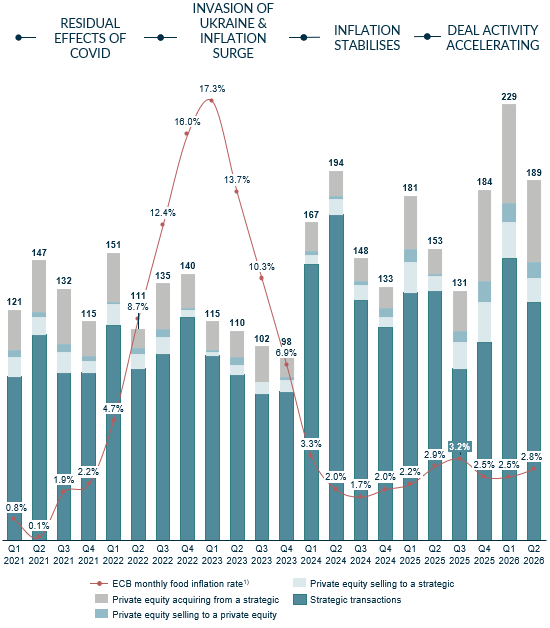
Note: 1) Calculated as the median of monthly rates over the period
Source: Mergermarket, European Central Bank
Download
The full report, including M&A deal activity, public company valuations & operating metrics as well as public comparables by subsector, can be downloaded at the top of the page.
Contact us
If you have any questions about the report, don’t hesitate to get in touch with one of our consumer team:

Andreas Kulcsar, Partner & Head of Consumer Europe

Ish Alg, Director
Previous Food, Beverage & Agriculture Reports
Food, Beverage & Agriculture | M&A Industry Update | Q4 2025
Food, Beverage & Agriculture | M&A Industry Update | Q3 2025
Food, Beverage & Agriculture | M&A Industry Update | Q2 2025
Food, Beverage & Agriculture – M&A Industry Update – Q1 2025